中国法院知识产权司法保护状况(2019)(2)
当今世界正处于百年未有之大变局,全球治理体系和国际秩序变革加速推进,全球新一轮科技革命与产业变革风起云涌,给知识产权司法保护提出了新课题、新任务和新挑战。人民法院将进一步把握新形势新情况,切实履职尽责,充分发挥知识产权司法保护职能,为实现经济持续健康发展和社会大局稳定,为全面建成小康社会和“十三五”规划圆满收官,为建设社会主义现代化强国和国家治理体系、治理能力现代化提供有力司法服务和保障。
Intellectual Property Protection by Chinese Courts(2019)
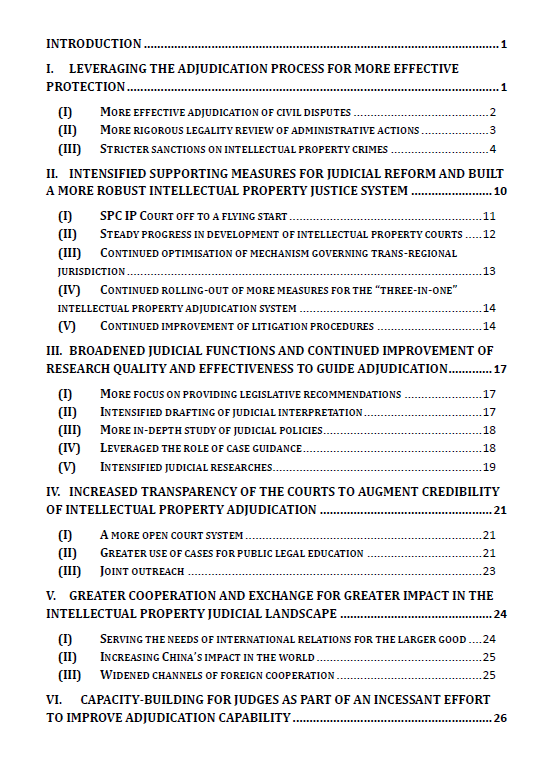
Introduction
2019 was the 70thyear of the founding of the People’s Republic of China. The same year saw theunfolding of the People’s Courts’ Fifth Five-Year Reform Programme (2019–2023).Guided by General-Secretary Xi Jinping’s thought on Chinese socialism for thenew era, the courts implemented the decisions and essential values of the 19thNational Congress of the Communist Party of China (“Party Congress”) and of thesecond, third and fourth plena of the 19th CCP Central Committee. They havealso continued to foster the “four aspects of consciousness”, the “four mattersof confidence” and the “two pillars to safeguard”, never losing sight of theiroriginal aspirations and mission. They pursued the national goal of building acomplete xiaokang society, discharged adjudication duties based on thelaw and the constitution, and intensified reform of the adjudication system toimprove adjudication efficiency, effectiveness and judicial credibility. Theyhave also ensured efficacious discharge of their adjudication duties. Havingdedicated significant effort to building an effective team, the courts rebootedand renewed the intellectual property adjudication regime to further elevatethe credibility and impact of China’s intellectual property adjudication at theinternational level. By continuing to modernise the intellectual property adjudicationregime and capacity, the courts have also enabled the delivery of robustjudicial services and enactment of judicial safeguards to underpin thecountry’s innovation-driven development and creation of a pro-businessenvironment.
I. Leveraging the adjudicationprocess for more effective protection
The 19th CCP Central Committee’s fourth plenary session issuedimportant directives to advance Chinese socialism and modernise the nationalgovernance system and governance capabilities. The session also gave instructions forthe country to improve systems and mechanisms to encourage technologicalinnovation, redouble efforts to build an innovation-based country andstrengthen national strategic technologies. To elevate China’s technologicaland innovation capabilities, drive quality economic growth and implement ourinnovation-driven development strategy, we need greater protection and utilisationof intellectual property to fashion an effective incentive structure. As thecourts “strive to make the people feel fairness and justice in every judicialcase”—a goal that centres on the people and fair justice—intellectual propertyadjudication has become an important means to incentivise and protectinnovation.
In 2019, the courts have accepteda total of 481,793 cases, including first instance and second instance casesand applications for extraordinary legal remedy to reopen cases.475,853 cases(including carried forward cases) were concluded, representing a respectiveyear-on-year increase of 44.16 % and 48.87%.
(I) More effective adjudication ofcivil disputes
Given the essential role ofintellectual property adjudication in protecting innovation and in levellingthe competitive playing field, adjudication has focused on encouragingtechnological innovation, promoting cultural transmission and maintainingmarket order to provide clear, consistent and predictable rules to guideadjudication and instil confidence among entrepreneurs and innovators.
In 2019, the Supreme People’s Court accepted2,504 new civil intellectual property cases and concluded 1,976 cases, respectively174.26% and 260.97% higher than the previous year. In the same year, the localcourts accepted 399,031 and concluded 394,521 first instance civil cases, wherethe respective year-on-year increases were 40.79% and 44.02%. Among the newlyaccepted cases, 22,272 were patent cases (2.64% year-on-year increase); 65,209 trademark cases (25.41% year-on-year increase); 293,066 copyright cases (49.98% year-on-year increase). There were also 3,135 cases ontechnology contract disputes, (16.98% year-on-year increase) and 4,128 unfair competitioncases, including 70 monopoly cases, (49.71% year-on-year increase). Other civil intellectualproperty disputes constituted 11,221 cases, or 49.71% more than last year. Forsecond instance cases, 49,704 were accepted and 48,710 concluded, translatingto a year-on-year increase of 79.95% and 85.29% respectively.
High profile civil disputesinvolving intellectual property heard and concluded by the courts during theyear include:
French automotive parts manufacturer Valeo Systemes D’Essuyage(plaintiff- appellee)vs. Lukasi Car Accessories(Xiamen) Co. Ltd (respondent-appellant) and Fuke Car Accessories (Xiamen) Co. Ltd. (respondent-appellant)et al. involving a utility patent infringement dispute; HondaMotor Company (plaintiff-appellee- petitioner) vs. Hengsheng Xintai (Chongqing) Trade Company (respondent-appellant-petitionee), Hensim (Chongqing)Group et al. (respondent- appellant-petitionee) involving a trademarkinfringement dispute; Hemujia Medical Management Consultancy(Beijing) Co., Ltd (plaintiff,-appellant-petitioner)vs. Hemujia Obstetrics andGynaecology Hospital (Fuzhou)(respondent-appellee- petitionee) involving unfair competition; Cai Xinguang (plaintiff-appellant) vs. RunpingCommerce (Guangzhou) Co., Ltd(respondent-appellee) involving infringement of new plant variety; and copyrightinfringement case of ShanrenSculpture (Hebei) Co., Ltd(plaintiff-appellant) vs.Zhongding Garden Sculptures (Hebei) Co., Ltd et al. (respondent-appellant) and the People’s Government of Sanhe Township, Bozhou District, Zunyi Cityet al. (respondent-appellee).
(II) More rigorous legality review ofadministrative actions
The courtshave strengthened legality review of intellectual property granted andvalidated by administrative authorities and of administrative enforcementactions. In 2019, the Supreme People’s Court accepted1,066 intellectual property cases involving administrative disputes andconcluded 884 cases. Compared to last year, the number of cases has risen by70.83% and 52.15% respectively. The same year saw local courts accepting 16,134first instance administrative cases (19.11% increase year-on-year), 1,661were patent cases (8.14% increase year-on-year), 14,457 trademark cases (20.56%increase year-on-year) and 16 copyright cases. 17, 938 first instance caseswere concluded (89.74% increase year-on-year). Local courts also accepted 7,304(104.88% increase year-on-year) second instance administrative cases, and 5,942cases were concluded (84.71% increase year-on-year), of which, decision wasupheld for 4,791 cases, first instance judgement was amended for 1,026 cases; 4cases were remanded for retrial, 613 cases withdrawn, and 132 cases overruled.
High profileintellectual property-related administrative disputes heard and concluded bythe people’s courts during the year include Huawei. Technologies, Co, Ltd(plaintiff-appellee) v. Samsung Electronics Co, Ltd (Thirdparty-appellant) and CNIPA (respondent) involving an administrative overthe invalidation of a patent; and Kangzhi Lesi Network Technology (Beijing)Co., Ltd (plaintiff-appellee-petitionee) v. Meiyou InformationTechnology (Xiamen) Co., Ltd (third party-appellant-petitioner) and CNIPA(respondent-appellant) involving an administrative dispute over theinvalidation of a trademark.
(III) Stricter sanctions onintellectual property crimes
Intellectualproperty crimes were subject to more rigorous adjudication toclean up the market, therefore better defend intellectual property fromcriminal infringement.
In 2019, thelocal courts accepted 5,242 first instance intellectual property-relatedcriminal cases, 21.37% higher than last year, including 4,982 cases relating toinfringement of registered trademarks ( 21.01% increase year-on-year), and 210 oncopyright infringement (34.62% increase year-on-year).
At the locallevel, 5,075 first instance cases were concluded during the year (24.88%increase year-on-year), including 2,134 cases involving counterfeiting ofregistered trademarks (15.23% increase year-on-year), 2,279 cases involvedselling goods bearing counterfeit registered trademarks (32.19% increaseyear-on-year), 423 were cases of illegal manufacturing or sale of goods bearingillegally produced registered trademarks (38.69% increase year-on-year); 1 caseinvolved counterfeiting patents, 191 were criminalinfringement of copyright, (40.44% increase year-on-year), 8 involved sellinginfringing reproductions (33.33% increase year-on-year), and 39 involved trade secret infringement crime (no changefrom last year).
For second instance intellectual propertycases involving criminal offences, the local courts accepted 808 cases (18.30% increaseyear-on-year), and 807 cases were concluded (23.70% increase year-on-year).
High profile criminal cases involvingintellectual property heard and concluded by the people’s courts during theyear include: Yang Fengming, Yang Maogang et al. for counterfeiting aregistered trademark; Lin Yixiang et al. involving infringement of tradesecrets; Xu Zhenwei et al. involving counterfeiting of registeredmark; and Chen Li et al. involving trademark infringement.
Intellectual property adjudication has madesteady progress in the year, and has scored higher in quality andeffectiveness. The key features for 2019 are:
New highs in caseload. Withincreased social awareness of intellectual property right and greatercredibility of the courts in adjudicating intellectual property disputes, thecourts have faced a spike in caseload. The total number of accepted andconcluded cases for the year 2019 were at historic high, both recording a year-over-yearincrease of more than 40%.
By geographical location, Beijing accepted80,165 cases, Shanghai 23,580 cases, Jiangsu Province 20,249 cases, ZhejiangProvince 27,706 cases and Guangdong Province 157,363 cases, totalling 309,063cases. This constituted 64.15% of China’s total case number and the greaterpart of the country’s intellectual property caseload. The areas that experiencedmore than 50% year-on-year increase in caseload were Hebei Province (53.53%),Anhui Province (60.30%), Fujian Province (64.88%), Guangxi Autonomous Region(98.49%) and Chongqing Municipality (173.66%). Despite facing manpowershortages, the courts have managed to dispose of a large number of cases duringthe year, with the total disposal number reaching historic high. Other thanbeing the most active regions, the courts in Beijing, Shanghai, JiangsuProvince, Zhejiang Province and Guangdong Province have also achievedcommendable disposal rates of more than 90%.
Continued emergence of new case genres. As the newround of technological revolution and industrial transformation rapidlyemerges, legal boundaries are increasing tested and pushed by new technologies,new products and new forms of business. New intellectual property issuesinvolving cutting-edge technology relating to the Internet, big data,artificial intelligence, standard essential patents, biomedicine have also continuedto emerge, requiring detailed examination of complex technological solutionsand creative application of the law, based on the merits of each case. Someexamples are:
The Supreme People’s Court: Heardpatent cases involving mechanics, material science, electrical engineering,communications, biopharmaceuticals, and fine-tuned the adjudication rules baseon the derived insights.
Beijing Intellectual Property Court: Heard andconcluded many significant and complex cases, including the first case relatingto the infringement of cloud servers, and preservation of evidence duringpre-trail for a case involving the infringement of a patent relating to the productionof stable lyophilised pharmaceutical composition.
Shanghai High People’s Court: Concluded Nokiavs. Shanghai Huaqin Communication Technology Co., Ltd involving the infringementof a utility patent. The case provides reference for tryingcommunications-related SEP disputes in the future.
Guangdong Province: The courtshave heard 63 patent cases, each involving a jurisdictional amount of more thanCNY 10 million, the aggregate amount of which was approximately CNY 8.18billion.
Continued to augment protection. The courtshave implemented the “Opinions on Improving the System of Property RightsProtection to Protect Property Rights According to Law” to provide more timelyand accessible judicial relief for intellectual property disputes, as well as tobalance the damages awarded with the market value of the intellectual propertyin question. Some exemplary efforts include:
Beijing: TheHaidian District People’s Court awarded damages of more than CNY 20 millionbased on discretionary valuation when Motion Scene (which operates UC browser)sued Sogou for using its Sogou Input Method to redirect the user to Sogou’ssearch website.
Inner MongoliaAutonomous Region High People’s Court: Increased the amountof damages from CNY 50,000 to CNY 1 million in the Guangdong Landai GroupBeijing Lanbao Beer Co., Ltd vs. Henan Honghuo Food Co., Ltd et al.trademark infringement case to sanction infringers more severely.
Zhejiang High People’sCourt: Ordered the respondent to pay CNY 8 million in damages for the Aupu ElectricalAppliances (Hangzhou) Co., Ltd and Aopu Home Furnishing Co., Ltd vs. Zhejiang FashionBuilding Materials Co., Ltd and Zhejiang New Energy Co., Ltd case involvingtrademark infringement and unfair competition. The court’s decision has protectedthe “AOPU” brand value.
Fujian Province: The courtsimposed punitive damages in the “JIU MU WANG (lit. ‘King of Nine Herds’)”trademark dispute and the “BOLIMO” trademark and unfair competition disputewhen the damages awarded were either doubled or trebled the amount forcompensatory damages.
Effects of judicial efforts were recognised. The courtshave done well in a series of complex and novel cases that attractedconsiderable public attention. The precedence would serve as classic cases thatare demonstrative and could guide future adjudication. Exemplary effortsinclude:
SPC IP Court: Issued decision forits first case immediately after the hearing, and the determination criteria forfunctional features were detailed in the written judgement. The hearing wasbroadcasted live and was widely reported by the media. Live streaming of thehearing—a case that took only 50 days to conclude from the date it was acceptedto service of judgement—attracted more than 18 million viewings. Opening up thecourtroom for public scrutiny has ensured fairness, transparency andefficiency.
Gansu High People’s Court: Concludeda new plant variety dispute involving a foreign party, thereby protecting thelawful rights of the plant breeder.
Shanghai Intellectual Property Court: Concluded aseries of cases, which include the utility patent dispute between NetacTechnology (Shenzhen) Co., Ltd and Transcend China (Shanghai) Co., Ltd. Thedisputes, which involved cutting-edge technology used in mobile storage and ajurisdictional amount of more than CNY 24.7 million, has attracted widespreadattention and much recognition.
Hunan Province: Adjudicated trademarkinfringement and unfair competition cases involving a wide range of servicesectors such as food and beverage, creative photography and department-storesales. The decisions provided direction for the regulated and reasonable use oftrademark by players in the food & beverage, department store and creativeindustries, which in turn supported the healthy growth of the service sector.
Remarkable ADR outcomes. The courtshave continued to turn to non-litigious alternative dispute resolution as theprimary means to settle dispute, and on promoting the new era FengqiaoExperience—a way of community-level social governance whereby public effortwas harnessed to maintain social stability. By actively encouraging the broaduse of ADR, parties were encouraged to resolve disputes through non-litigiousmeans by working together to find mutually agreeable and beneficial ways tosettle intellectual property disputes efficiently. Exemplary efforts include:
The Supreme People’s Court : Successfully mediated the trademark infringement case of Henan DukangInvestment Group vs. Shaanxi Baishui Dukang Company, and permanentlyresolved all cases relating to the “DUKANG” (believed to be a minister underthe mythological Yellow Emperor and originator of winemaking) trademark issue. Thecourt’s efforts have contributed to improving the stability of the local marketand providing protecting local businesses. It established a nation-widewhole-of-system coordinating mechanism to explore a circuit adjudication modelcombining the workings of an IP court and a circuit court, and an adjudicationmechanism combining onsite examination (kanyan) and hearing, and hassince facilitated the unified settlement of 48 related cases nationwide. Italso enabled the efficient resolution of 80 patent infringement cases at thepre-trial stage. The court’s efforts have made litigation easier and enabledthe Fengqiao Experience to enrich the intellectual property sector.
Beijing: Continued to drivereform of the “ADR + expedited procedure” as part of the city’s effort tomodernise the capital city’s social governance system and governance approach.
Jilin Province: The courts focused onusing mediation to resolve disputes. Total mediation rate for intellectualproperty disputes was 75%.
Anhui High People’s Court: Succeededin mediating the dispute between China Broadcasting Satellite TV and ChinaTelecom Anhui Branch concerning the infringement of broadcasting right, with ajurisdictional amount exceeding CNY 100 million.
Shandong Province: The courts implementedthe “Regulations to Promote Use of Alternative Dispute Resolution for ShandongProvince” and worked at developing a platform to align litigation withmediation.
Hubei Province: The courts coordinatedresources and established mediation platforms comprising administrative organs,lessors of the site where infringement occurred, industry associations, attorney-mediationorganisations to facilitate mediated settlement of disputes.
Sichuan Province: The courts enteredinto a cooperation agreement with the China (Sichuan) Intellectual PropertyProtection Centre to develop a mechanism to provide coordinated protection ofintellectual property. Under the agreement, the centre was appointed to mediateintellectual property-related disputes.
Yunnan Province: The courts establisheda pre-trial mediation system for intellectual property cases to enable theprompt resolution of a certain proportion of intellectual property disputes.
Liaoning Province: The courts beefed upexisting ADR mechanism by using pre-trial mediation for copyright, trademarkand unfair competition cases if the facts are clear and minimally disputed. Themechanism has enabled the courts to align litigation with mediation.
Xinjiang Autonomous Region: The courtsfocused on using mediation to settle dispute, translating to a rather highpercentage of post-mediation withdrawal rate.
II. Intensified supporting measuresfor judicial reform and built a more robust intellectual property justicesystem
In 2019, the courts leveraged the “Opinions on Several Issues on Reformand Innovation Relating to Intellectual Property Adjudication” to develop moreinnovative theories and institutions and adopt more innovative practices. Asuite of relevant reforms was also instituted as part of the courts’ effort tocontinue building better systems and mechanisms for intellectual property.
(I) SPC IP Court off to a flyingstart
Creatingthe Intellectual Property Court (SPC IP Court) within the Supreme People’sCourt was an important move by the Party Central Committee, with Xi Jinping asthe core, based on the strategic vision of building an intellectual propertypowerhouse and a high-tech global superpower. It was an important milestonemarking a major breakthrough and innovative step in our intellectual propertyadjudication system.
2019 isthe SPC IP Court’s first year of operation. As an agency tasked to hear all appealcases of technology-related intellectual property disputes, the SPC IP Courthas overcome the early difficulties to drive comprehensive progress bylaunching copious reform initiatives that have scored preliminary successes.
First, it unified adjudication standards . Unificationof adjudication standards was the primary objective of creating the SPC IPCourt. The “Rules of Implementation of a Unified Adjudication Standard for the IntellectualProperty Court of the Supreme People's court”, among others, was developed toensure that the entire process, from preliminary analysis to mid-processcontrol, final review and approval and stringent management of important cases,were well- administered. Also, the “Minutes of the Conferences of Judges” werecompiled and “Guidelines on Case Operations” prepared and distributed to unifyadjudicative standards and methods for handling similar cases.
Second, it explored combining the hearing of administrative andcivil disputes. Disputes relating to civil infringement andadministrative validation involving the same patent was heard by the sameadjudication panel to ensure alignment of the civil and administrativeprocedures and consistency of adjudicative standards.
Third, it optimised the mechanism for adjudicatingtechnology-related intellectual property disputes. Living by itsmotto of people-centredness and being dedicated to delivering optimaladjudication management, the court leveraged its advantage as the centralcoordinating authority and the “1+76” hierarchical structure to resolve linkeddisputes within the country.
Fourth, it continued to develop the multiprong technicalfact-finding mechanism. By coordinating technical investigationresources in the country, including more than 360 technical investigators frommore than 30 technical fields, the SPC IP Court worked at alleviating theproblems faced by the courts, including inadequacies in technical investigationfor the less-developed regions and the lack of specific technical expertise in developedregions.
Fifth, it strengthened informatisation and adoption of smarttechnology. The court has built case and adjudication rules databases,and created smart platforms such as the "Big Data Intellectual PropertyAnalysis Platform". It also explored the creation of an "IP CourtCloud". These were endeavours to meet the demands of parties for onlinesubmission of evidence and online reading of case files, and would become the technologicalbedrock for adjudicating technology-related intellectual property disputes.
(II) Steady progress in development ofintellectual property courts
Toimplement the National People's Congress (NPC) Standing Committee’s reviewopinions on the progress of local intellectual property courts, the SupremePeople's court continued to provide more guidance for the Beijing, Shanghai andGuangzhou intellectual property courts, which have continued to make smooth progressand achieve remarkable outcomes.
Sincetheir establishment at the end of 2014, the intellectual property courts haveaccepted more than 100,000 cases and heard intellectual property cases of internationalimpact and which are important basis for crafting adjudication rules. They werealso instrumental for improving the quality and efficiency of hearings,ensuring consistency in decisions, and facilitating innovation-drivendevelopment. The courts have also leveraged their functional positioning toexplore bold and innovative initiatives to drive judicial reform thatengendered a new intellectual property adjudication landscape. The reforms alsoenabled specialisation, an important feature that has helped buttress judicialprotection for intellectual property.
(III) Continued optimisation ofmechanism governing trans-regional jurisdiction
Since2017, specialised judicial organs (IP divisions) were established within 21intermediate courts, such as the Nanjing Intermediate People’s Court, to facilitatecentralised jurisdiction over certain categories of trans-regional firstinstance intellectual property cases and enable specialised intellectualproperty judicial organs to be rationally distributed. The IP divisions havededicated themselves to exploring innovative initiatives and to improving thelevel of specialisation, an important effort that would drive the co-ordinateddevelopment of the Beijing-Tianjin-Heibei (Jing-Jin-Ji) region, and the developmentof the Yangtze River Economic Belt and the Guangdong-Hong Kong-Macao GreaterBay Area (Greater Bay Area). Exemplary work by several local IP divisionsinclude:
Nanjing:Conducted circuit trials, implemented specialised and centralised adjudication,and responded to the demands of high-tech industrial parks to protect theintellectual property of business innovations.
Hangzhou:Leveraged internet technology and established a trans-regional cooperationmechanism to facilitate access to online hearing and standardised applicationof the law.
Zhengzhou:Digitised processes such as introduction of online filing and acceptance ofcases, electronic service of documents and WeChat mediation to overcome timeand spatial constraints, as part of its effort to provide easy access and to increasethe level of informatisation.
Shenzhen:Capitalised on the city’s geographical advantage to strengthen judicialprotection of intellectual property by participating in the development of theGuangzhou-Shenzhen Science and Technology Innovation Corridor and the PearlRiver Delta National Demonstration Zone for Home-Grown Innovation.
Haikou: Tookthe initiative to protect intellectual property by establishing circuit-courtstations and contact points for judicial services within different parts of theprovince.
(IV) Continued rolling-out of moremeasures for the “three-in-one” intellectual property adjudication system
In 2019, the courts implemented the “Supreme People's ‘s Opinions onPromoting ‘Three-in-One’ Adjudication of Intellectual Property-Related Civil,Administrative and Criminal Cases” to further consolidate the results of the"three-in-one" reform.
SupremePeople's Court: Reviewed case files relating to intellectualproperty crime to distil first-hand information on criminal adjudication. Thiswill allow more in-depth examination of the norms of adjudicating intellectualproperty criminal offences, based on which, the relevant judicial interpretationscould be revised and improved.
JiangsuHigh People’s Court: Initiated a study relating to the sentencingof intellectual property crimes to provide reference for standardising the useof sanction discretion and in sentencing.
ZhejiangProvince: Since 1 November 2019, all the courts in Zhejiang Province haveimplemented the “three-in-one” adjudication procedure. 260 criminal offencesand 41 administrative disputes were heard during the year.
HainanHigh People’s Court: Initiated research studies on using designatedjurisdiction for intellectual property criminal offences, and clarified the jurisdictionmechanism for "three-in-one" adjudication for intellectual propertycases.
(V) Continued improvement oflitigation procedures
The People’sCourts worked on improving the rules of procedure based on the merits ofindividual intellectual property cases and on developing an optimaladjudication approach to overcome institutional obstacles.
First, giving reasonable guidance in evidenceproduction. The courts have developed innovative measures tostrengthen the burden of proof by enabling ex-officio investigation andcollection of evidence to effectively reduce the costs borne by right-holders.
Shanghai High People’s Court: Explored the use of an evidenceproduction order such that any behaviour that obstructed the production ofevidence would be punished under the law.
Hunan High People’s Court: Regulated policies and proceduresrelating to investigation orders for lawyers.
Hainan High People’s Court: Parties were encouraged to make fulluse of third-party means such as notarisation and electronic data platforms tocollect and preserve evidence.
Second, building a more robust fact-findingmechanism. The courts have elaborated the ways which differentpersonnel could participate in the investigation of technical facts, and have mobilisedmanpower and resources to develop a dynamic and coordinated system for fact-finding.
Supreme People's Court: Created a pool of experts comprisingtechnical investigators and technical advisory experts employed and appointedby the courts, and established a national mechanism for sharing oftechnical-investigation resources among the courts. It also launched the"Work Manual for Technical Investigators (2019)" to guide the courts intechnical fact-finding and regulate their technical fact-finding activities.
Beijing Intellectual Property Court: Established a"four-in-one" technical fact-finding mechanism, comprisingspecialised people's assessors, technical investigators, expert assessors andforensic institutes.
Jiangsu High People’s Court: Entered into a framework agreementwith the Jiangsu Province Collaborative Innovation Centre for BiomedicalFunctional Materials, where the parties would cooperate on intellectualproperty-related technical fact-finding. The cooperation enabled the court toengage technical experts to assist in intellectual property cases.
Production and Construction Corps Branch of the Higher People's Court ofXinjiang Uygur Autonomous Region: When preserving evidence, professionals were engaged to survey thelocation and the planting area of infringing seeds, and to collect samples of infringingplants .
Hubei, Hunan, Sichuan and Shaanxi High People’s Courts: Formedexpert pools to tap professional expertise and improve the accuracy oftechnical fact-finding.
Third, optimisation of adjudication approach. Giventhe diverse judicial needs, the different levels of courts have sought tooptimise their adjudication approaches through a diversion mechanism that separatesthe complicated cases from simple ones, and that applies a unified standard whenapplying the law.
Beijing Intellectual Property Court: Implemented thespeedy trial mechanism, and introduced a pilot that judges would issue"abridged written judgments" for trademark review cases. Averagedisposal time was reduced by 30%.
Xi'an IP Division: Formed an adjudication team to conductspeedy trial, an approached that required only 20% of the manpower to hear 70%of the cases.
Chengdu IP Division: Explored the use of speedy trialmechanism for intellectual property disputes to better allocate adjudicationresources. The outcomes were encouraging.
Haikou IP Division: Implemented an integrated model ofoperations that combined case acceptance, adjudication and enforcement underone operational framework to improve adjudication quality and effectiveness.
Changchun IP Division: Introduced speedy and simplifiedtrials for copyright and trademark disputes. 84.8% of the cases were concludedwithin five months, and the adjudication cycle was substantially shortened.
III. Broadened judicial functions andcontinued improvement of research quality and effectiveness to guideadjudication
Always vigilant ofhot button issues, the People’s Courts have leveraged the Supreme People’sCourt’s Intellectual Property Judicial Protection Research Centre and itstheoretical research base to strengthen development of intellectual propertyprotection-related innovative theories and research of the relevant judicialpolicies. They have also actively participated in the revision of intellectualproperty-related laws and provided effective judicial supervision and guidance.
(I) More focus on providing legislativerecommendations
The courts haveactively participated in the revision of laws and regulations such as the CivilCode, Patent Law, Trademark Law, Anti-Unfair Competition Law, Copyright law,Regulations on the Implementation of the Trademark Law, and Regulations on theProtection of New Plant Varieties.
Other legislativeendeavours include participating in thefourth forum on Patent Law amendment, and CPPCC’s meeting on folkliterature and artistic works relating to the drafting of the amendments to theCopyright Law. The courts also initiated researches on a special procedure lawfor intellectual property litigation, established the general direction, basicframework and key content of the research.
(II) Intensified drafting of judicialinterpretation
The Supreme People's Court issue the “Provisions on the Participationof Technical Investigators in Intellectual Property Litigation” setting forththe procedure, responsibility, validity, liability relating to theparticipation of technical investigators in intellectual property litigation.It also researched on topics such allocation of the burden of proof,investigation and collection of evidence, exchange of evidence, and examinationand determination of electronic evidence. The court also organised variousseminars on the drafting of judicial interpretation for punitive damages forintellectual property infringement, application of the Trademark Law and LawAgainst Unfair Competition, trade secrets, and national defence patentdisputes.
(III) More in-depth study of judicialpolicies
The courts participated in the drafting of the “Opinions onStrengthening the Protection of Intellectual Property”, allowing specialisedintellectual property adjudication organs such the Guangzhou IntellectualProperty Court and the Shenzhen Intellectual Property Division to play biggerroles, and stepped up cooperation in GBA-related intellectual propertyprotection and professional training. For Guangzhou Knowledge City (GKC), thecourts also pressed ahead with the national comprehensive reform pilotprogramme to better utilise and protect intellectual property.
To better serve the free trade zones, special studies on theprotection of intellectual property were conducted, based on which, 38initiatives relating to the judicial protection of intellectual property forthe development of free trade zones and free trade ports were proposed.
(IV) Leveraged the role of caseguidance
